
If religion is declining, how do dissenting religious groups survive?
In an age of declining church attendance, growing distrust in institutions and increasing numbers of people identifying as having “no religion”, it is often assumed that religion is fading away.
But this assumption misses something important.
While mainstream religious institutions may be losing influence, dissenting religious communities—those on the margins, operating outside official structures—continue to endure. In some cases, they are even thriving. In Britain and beyond, small, committed groups continue to gather, practise and pass on their beliefs, often in ways that are largely invisible to wider society.
Across history, dissenting religious communities have faced persecution, marginalisation, internal division and, at times, outright rejection by both church and state. Yet many of them endure—not just for decades, but for centuries. From the Quakers of the seventeenth century, Mormon pioneers in the nineteenth, traditionalist Catholics in the twentieth, and newer alternative spiritual communities in the twenty-first century, dissent has proven remarkably resilient.
This persistence presents a problem for how we usually think about religion in modern society. A common assumption is that religion declines as societies modernise—that science, bureaucracy and secular institutions gradually replace belief. Even when religion does survive, it is often assumed to do so through strong leadership, clear doctrine or institutional power.
But what if this is the wrong way to look at it?
My research suggests that dissenting religions do not survive primarily because of what they believe, or even because of who leads them. Instead, they endure because dissent becomes embedded in everyday life. I call this idea “lived dissent.”
Beyond Belief: What Sustains Dissent?
Traditional explanations of religious survival tend to focus on moments of origin—charismatic leaders, theological disputes or institutional breakaways. These moments matter, but they do not explain why dissent continues long after those initial conflicts fade.
Leaders die. Doctrines evolve. Institutions fragment. And yet dissenting communities often persist.
To understand why, we need to shift our attention away from formal structures and towards the ordinary, everyday practices of believers.
“Lived dissent” builds on the idea of “lived religion”—the study of how religion is practised in daily life—but focuses specifically on what makes dissent durable. It asks a different question: not why dissent begins, but how it survives.
The Everyday Life of Dissent
When we look closely at dissenting communities, a pattern emerges. Across very different historical contexts, they rely on similar kinds of everyday practices.
Take family life. Dissent is often transmitted through kinship networks, with entire families converting together and sustaining belief across generations. In the case of Quakers, families endured fines, imprisonment and social exclusion collectively. Among early Mormons, conversion and migration to America frequently occurred in family groups. Traditionalist Catholic families in the twentieth century travelled together to attend unofficial Latin Masses, bringing their children into these practices from a young age.
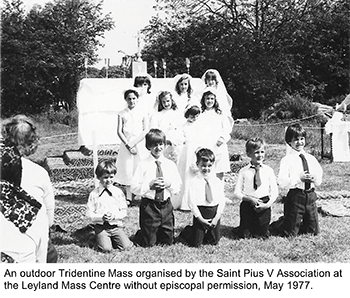
Or consider domestic space. When official venues are unavailable—or forbidden—homes become sites of worship. Quaker meetings were held in private houses during periods of persecution. Mormon converts hosted missionaries and organised gatherings in domestic settings. In the 1970s, traditionalist Catholics transformed kitchens and living rooms into improvised Mass centres.
Hospitality also plays a crucial role. Dissenting communities often depend on networks of support that operate outside formal institutions. Households shelter travelling preachers, host religious gatherings and provide infrastructure for movements that might otherwise collapse.
Communication networks reinforce these ties. Letters, pamphlets and newsletters circulate ideas, strengthen identity and connect dispersed communities. In the nineteenth century, correspondence between Mormon emigrants in America and relatives in Britain encouraged further conversion and migration. In other cases, printed materials helped maintain shared beliefs across distance and time.
Even mobility becomes part of dissent. Whether relocating to avoid persecution or travelling long distances to attend services, movement helps sustain identity. For some, this meant crossing oceans; for others, simply driving across counties to reach a sympathetic congregation.
These practices may appear ordinary, even mundane. But together, they form what we might call the infrastructure of dissent—the everyday mechanisms through which alternative religious identities are maintained.
Three Forms of Dissent
Looking across these examples, we can also see that dissent takes different forms.
Some movements promote egalitarian dissent, challenging existing hierarchies and advocating more inclusive forms of belief and practice. Early Quakers, for instance, emphasised spiritual equality and rejected traditional clerical authority.
Others embody primitive dissent, seeking to return to what they see as a purer, original form of religion. Mormonism in the nineteenth century framed itself as a restoration of early Christianity.
Still others represent reverse dissent—the continuation of practices that were once mainstream but have since become marginal. Traditionalist Catholics who preserved the Latin Mass after the reforms of the Second Vatican Council fall into this category.
Despite their differences, these movements share a reliance on lived, everyday practices that sustain dissent over time.
Rethinking Secularisation
What does this mean for how we understand modern society?
For a long time, scholars have described secularisation as a linear process: as societies modernise, religion declines. But the persistence of dissenting communities complicates this narrative.
In many cases, modernity does not weaken religious commitment—it reshapes it. Periods of rapid social change, whether driven by industrialisation, political reform or institutional transformation, can actually intensify dissent. In uncertain times, dissent offers something powerful: coherence, identity and a sense of resistance.
Rather than being a relic of the past, dissent may be a distinctly modern phenomenon.
This challenges the idea that religion simply fades away. Instead, it suggests that religion adapts, often in ways that are less visible but no less significant.
Why It Matters
Understanding lived dissent is not just about religion. It tells us something broader about how communities survive in the face of pressure.
In an era marked by social change, institutional distrust and shifting identities, many groups—religious or otherwise—are finding ways to sustain themselves outside formal structures. They rely on informal networks, everyday practices and shared experiences rather than centralised authority.
Dissent, in this sense, is not an anomaly. It is a recurring feature of modern life.
Where Dissent Lives
If we want to understand why dissent endures, we need to look in different places.
Not just in churches, doctrines or official institutions—but in homes, families, letters, journeys and everyday routines. It is in these spaces that dissent is lived, transmitted and sustained.
Because in the end, dissent does not survive through institutions. It survives because people build it into the fabric of their everyday lives.
Dr Brandon Reece Taylorian AFHEA is a Research Associate in the School of Psychology and Humanities at the University of Lancashire.